I was 12 when Titanic (1997) premiered. I saw the movie four times in the theatre and multiple more times once it came out on video. But after I turned 14, I turned my back on Titanic and didn’t watch the movie again until I began this project. I was not excited to watch it again, but I was hooked as soon as I saw Leonardo DiCaprio’s eyes (incidentally, the same thing that caused me to drop $40 of hard earn allowance money on tickets the first time around).
We all know the story (unless you were under a rock throughout the late 1990’s and even if you were the only person never to have viewed the film, you should still know how it ends), so I’ll keep the recap brief.
Bill Paxton (pre-polygamy days) is a high-tech grave robber who is attempting to find a giant blue diamond necklace that is assumed to have gone down with the Titanic. Instead he finds a nudie drawing of a hot chick who is now 100 years old. She sees the drawing on the local news (who knew they could show drawn boobs?) and she calls up Bill Paxton. The next day she, her granddaughter (played by James Cameron’s wife) and her dog are aboard Bill’s boat. She begins telling the story of her trip in the Titanic, which throws us back in time to 1912.
Rose is a wealthy red head who is engaged to an asshole. They (along with Rose’s overbearing mother) are taking a trip back to the USA on the Titanic. Leonardo DiCaprio, or Jack, as he is known in this film, wins Titanic tickets in a poker game. They meet one night after Rose tries to jump overboard (she doesn’t like being rich or engaged to a rich guy or something). Jack stops Rose from committing suicide and the two become close. He shows her a good time boozing and dancing in steerage and her fiancée gets really upset. To win her love back he gives her a giant blue diamond necklace shaped like a heart. She doesn’t really like it, so she runs off with Jack (as much as one can “run off” on a ship). She asks Jack, who is an artist, to draw her naked wearing only her necklace. After that they do it in a car (I know you remember the steamed up windows with the hand print).
Their sex in a car causes the Titanic to hit an iceberg. The boat doesn’t have enough lifeboats, so only the wealthy women and children get off the sinking ship. Rose decides to stay with Jack and after about an hour of wondering when these people are going to drown, the boat goes down. Jack and Rose hold hands, vowing to ‘never let go’. Jack dies, Rose gets saved. On the rescue ship she almost runs into her old fiancée, but covers her face so he can’t see her. She changes her name to “Rose Dawson” taking Jack’s last name.
The movie ends with old lady Rose throwing the diamond necklace into the water. Oh yeah, then that Celine Dion song about her heart going on plays over the credits.
There we go. Four hours in three paragraphs.
In case you forgot why you were so excited to see this movie in 1997, here's the trailer.
Titanic was nominated for 14 Oscars and won 11 of them. According to AFI, Titanic is the 83rd Best Movie of All Time (2007 list), My Heart Will Go On is the 14th Best Song from a Movie, and Jack’s line “I’m the King of the World!” is the 100th Best Line of All Time.
Titanic will be re-released in 3D in 2011, so get excited.
While this movie took me back to my tween days, I’m not as much of a fan as I used to be. Titanic gets three statuettes out of five from me, and two of those belong to Leonardo DiCaprio’s eyes.
I’ve felt guilty about never watching Annie Hall (1977) my entire life. I feel like I’ve never lived a year without someone saying, “You’ve never seen Annie Hall? You’d love it, you’ve got to watch it.” It even arrived at my home via Netflix once, but my husband didn’t have any desire to watch it, so it was returned, unwatched. So when it arrived for a second time I opened it immediately, climbed into bed and hit play. And I will admit, it was pretty fabulous. Definitely a movie I should have seen years ago, or at least last October when Netflix sent it the first time.
Annie Hall also took my Woody Allen virginity, and I’ll say, I’m pretty excited to climb back in the sack with him again.
Annie Hall is the story of a neurotic Jewish comic, Alvy Singer (Woody Allen), who lives in New York City. After two failed marriages, he falls in love with Annie Hall (Diane Keaton). They meet through a mutual friend at a tennis match and Annie invites Alvy up to her apartment for a glass of wine. They couldn’t be more different, he sees a shrink three times a week, she smokes grass before every sexual encounter. He was born and raised in Brooklyn, she’s from rural Wisconsin. He’s obsessed with death and on one of their first dates he purchases her two books on death, she’s an untrained singer that likes to moonlight at Open Mic Nights. You can see where this is going, right? Alvy tells her that she’s not smart and pushes her into taking college classes. She does and begins a relationship with her professor. Alvy and Annie break up. He goes out with another girl (Shelley Duvall, who I recognized from The Shining). Annie calls Alvy one night and he comes to her apartment to kill a spider. Annie begins to cry and tells Alvy she misses him. The couple reunites.
Things are fine between the couple for awhile. But eventually old problems return. Annie begins seeing a therapist and confides in her that things between her and Alvy aren’t working. Alvy confides the same to his therapist. The couple flies to California (a state which Alvy despises) so Alvy can present an award on television. Annie likes L.A., and at a house party she meets up with Tony Lacey, a music producer (played by Paul Simon). Alvy and Annie split up and Annie moves to California. Alvy misses Annie terribly and flies to L.A. to see her. They meet at an organic food restaurant (which Alvy obviously loathes) and sees that Annie is happy in California. He returns to New York, writes a play about their relationship, but edits the ending so the pair end up together. Alvy tells us that he and Annie are now friends, and that even though the relationship was painful, it was worth it all in the end.
The movie is incredibly funny and by far one of the most entertaining Oscar winners I’ve seen. It’s full of great one liners (“My grammy never gave me gifts. She was too busy getting raped by Cossacks.”) and flashback scenes with young Alvy that will crack you up. Also, it’s chocked full of celebrity cameos including Jeff Goldblum and Christopher Walken (what movie isn’t that guy in?). Truman Capote even makes a cameo as a “Truman Capote look-a-like”.
Here's the trailer for Annie Hall. Gotta love the line about "VPL".
Annie Hall was nominated for five Oscars and won four. Woody Allen was nominated for Best Leading Actor, but lost to Mr. Holland (Richard Dreyfuss for those of you who haven’t seen that musical masterpiece) who starred in The Goodbye Girl.
AFI listed Annie Hall as the 31st Best Movie of All Time and the 4th Best Comedy of All Time.
As for me, I happily give this movie five out of five statuettes. I can’t wait to watch it again.
Alright, so I’ll be honest. Before beginning this project I’d only viewed 24 Oscar winners, but I’d at least heard of the majority on the list. The Last Emperor (1987) is one of the few exceptions. I’d never heard of the film (granted I was two when the movie was released) nor had I heard of anyone in the movie, except for the wonderful Peter O’Toole (who I recently watched in his stint on Showtime’s The Tudors, he makes an excellent Pope). What I knew of the movie before I watched it was the two sentence synopsis on my Netflix On Demand screen. What I knew of Chinese history, the topic of this movie, was nil. So let’s just say that watching The Last Emperor was a learning experience on many fronts.
As the name may suggest, The Last Emperor tells the story of the last emperor of China, Pu Yi. The movie takes place throughout his life from 1908 to 1967. It begins in 1950 at a Chinese train station. A prison train pulls into the station and prisoners of war empty out of the train. The prisoners wait in the train station and a few bow down before a fellow prisoner who is Pu Yi. They are led away by guards. Pu Yi walks to the bathroom, locks the door, and slits his wrists.
We’re then transported to 1908 when three year old Pu Yi is taken to the Forbidden City and crowned the Emperor of China. He is an absolutely adorable little boy and I wish scenes of young Pu Yi would have lasted longer. There are a few strange moments when we see the imperial physician check Pu Yi’s stool and the young emperor in bed with his wet nurse.
The film flips back to 1950 and Pu Yi’s suicide attempt has failed. He is then taken to prison.
We next see Pu Yi in 1914 when he is eight. His brother comes to visit. The two boys play together and things go well until his bother informs Pu Yi that he isn’t the real emperor of China. Pu Yi gets pretty pissed and, in order to prove that he is emperor, makes his servant drink ink. Nasty. The boys climb the walls of the Forbidden City and see a man in a car. Pu Yi’s brother informs him that the man in the car is president of China. His advisors tell him that China does in fact have a president and is a republic. Tough break for such a young dude.
The brothers meet again in 1950 at the prison. The prison governor begins to read a book about Pu Yi’s life written by his tutor.
The film flips to 1919 and we see Pu Yi meet his tutor, who is from Scotland. This is the beginning of Pu Yi’s fascination with the Western world. His tutor, Reginald, quickly becomes his best friend and confident. Pu Yi seeks his advice and Reginald often speaks to the emperor’s advisors on his behalf. The emperor marries two women in 1922, Wan Jung who is the empress and Wen Hsiu who is his secondary wife. They all have sex together. There do seem to be some perks to being a fake emperor of China.
Back in prison Pu Yi is brought to testify to his war crimes. We quickly learn that Pu Yi had a relationship with the Japanese and that is why he is now in prison.
In 1924 the Chinese government expels the emperor from the Forbidden City. They make arrangements to go to the British Embassy, but instead flee to the Japanese Embassy. The Japanese had offered to help Pu Yi and his family who were no longer considered Chinese citizens. Pu Yi sells many family possessions and lives a comfortable life with his two wives. He parties, drinks, and sleeps with many women. He still dreams of moving west. Pu Yi and Wan Jung have even taken western names ‘Henry and Elizabeth’. Wen Hsiu decides that she’s sick of playing second fiddle in this marriage and leaves.
Then trouble arrives. A Japanese spy named Eastern Jewel (I’m not making this up) arrives at the home of Pu Yi and Wan Jung. She gets wan Jung hooked on opium and also sways Pu Yi to the side of Japanese.
Back in prison we learn that Pu Yi claimed that he was kidnapped and taken to Japan against his will. In a flash to 1932 we see that Pu Yi went to Japan of his own free will. He convinces the Japanese to allow him to become the emperor of Manchuria, a portion of China that is no longer under Chinese rule. He becomes incredibly power hungry and his life begins to fall apart. His wife, who is so hooked on opium she sleeps with another man and is impregnated, is sent away. The Japanese surrender in 1945 and Pu Yi is forced to evacuate Manchuria. As he attempts to escape, he is captured by the Russians, who eventually turn him over to the Chinese. This is how he arrived in prison.
Pu Yi admits that he is responsible for his actions and serves nine years in prison before his release. The movie ends in 1967 with Pu Yi’s return to the Forbidden City.
Whoa. Trust me, that was the brief version. Watching the movie will definitely provide you with more detail, but you get the picture.
I’d also like to put a disclaimer on this film. If you’re thinking this would be a great way to teach your children about Chinese history, I suggest you find a G rated film. Unless you’re ready to explain why the emperor has a wet nurse until he’s nine, why he sleeps with two women at once, and why the empress is kissing women. And of course, this is a movie, and something were changed for time and plot continuity – it’s not exactly spot on historically.
The Last Emperor was nominated for and won nine Oscars including Best Musical Score which was A.MAZ.ING.
Here's the trailer, which will give you a great snippet of the music.
I really liked this film and feel that I definitely need to view it again, because I’m sure I missed many things. This one is a four out of five statuettes.
One Flew Over the Cuckoo’s Nest (1976) was the first, what I would deem, modern movies I’ve watched on my quest to view all 82 winners and the first one in color! Additionally, it was the first movie that I watched starring someone that I had grown up watching on the big screen. I’d heard of a lot of the other actors that starred in the films I’ve watched, but for the majority of them their Oscar winner was the first time I’d ever seen them on film. Not so with the great Jack Nicholson, who I’ve seen in just about a million movies. I’ve also heard from lots of people that One Flew Over the Cuckoo’s Nest is a great film. While I enjoyed this movie, I didn’t think it was spectacular. The message was great, the acting was amazing, but it lagged to the point where there were times I wished it was over. You could definitely tell this film was based off a book; at times I felt like I was watching a book on my screen.
Jack Nicholson plays Randle Patrick McMurphy criminal who is a repeat offender. He was sentenced to time in prison for statutory rape and has been transferred to a mental institution for evaluation. It seems like Randle has been faking mental illness to avoid the hard labor sentence of prison. At the mental institution Randle’s floor is run by a hard-ass nurse named Nurse Ratched. She’s pretty much a dictator, which is in direct contrast to Randle’s anti-authoritarian attitude. They are like oil and water from the beginning.
Ratched runs group therapy sessions with the patients on the floor that boarder on humiliating. It seems as if almost everyone on the floor is slightly brainwashed by her which is how she maintains order. Randle finds that the other patients, all male, are more focused on their fear of Ratched than they are on getting better and returning to the outside world.
One of the best parts of the movie is the cast of characters that live in the mental institution. There’s the stuttering Billy, the delusional Martini (played by Danny DeVito), Chief who is an enormously tall Native American, and a few others. Chief and Randle become the closest, as most people think Chief is mute, but Randle talks to him and treats him as an equal.
Randle becomes the de facto leader of the floor, causing as much trouble for Ratched as possible. Power begins to turn towards Ratched though when Randle learns that he cannot leave the mental institution but all of the others are their voluntarily. This news seems to knock him off his feet a bit.
One day Randle helps the other men on the floor escape for a day to go deep sea fishing. Ratched’s reaction is to double down her humiliating sessions and attempt to break Randle. The hospital attempts to give Randle electroconvulsive therapy (ECT) which does not work in settling him down. After his ECT session Chief opens up to Randle and speaks to him, bringing the two of them even closer.
Randle sneaks girls into the hospital one night and throws a party on the floor. Billy (the stutterer) and one of the women spend the night together while the other patients drink themselves to sleep. Nurse Ratched walks into the hospital to see this scene and tries to embarrass Billy by telling him she’ll call his mother. Billy is so distraught that he kills himself. Randle is so upset by Billy’s death he tries to choke Ratched with his bare hands. Randle is taken off the floor.
He returns later that night and it is clear that something has happened to him. Chief sees that he is unresponsive and it becomes clear that the hospital has given him a lobotomy. Chief, who can’t stand to see his friend like this, smothers Randle to death with a pillow. He then breaks a window and escapes from the hospital.
The end is the movie is incredible touching and is truly a testament to the power of friendship. The movie really does make you think about what crazy actually means. My interest was also sparked enough to want to read the book. It’s deep and I wouldn’t watch it if you’ve had a rough day.
Here's the trailer. I don't think it does the movie justice.
One Flew Over the Cuckoo’s Nest won the top five prizes at the Oscars (Best Picture, Actor, Actress, Director, and Screenplay). It was the second movie to ever do so, after It Happened One Night (1934). According to AFI it is the 20th Best Movie of All Time out of 100.
I’ll give this one four out of five statuettes. Definitely on the “Watch Again” list.
So many of the films on the Oscar winner list I’ve never heard of or seen, but there are a few that I’ve heard of before and never seen. From Here to Eternity (1953) was one of those movies. I knew I’d heard of From Here to Eternity before, but I could not for the life of me remember why or where. So when I sat down to watch it and discovered that it was another war movie (I had just finished All Quiet on the Western Front) I wasn’t thrilled. I know, I’d better get use to war movies, because a lot of them won Oscars. Anyway, about a half hour into the film I gasped the famous Garvey Gasp known to all in the John Moy family and choked on my Diet Coke. I suddenly realized why I’d heard of this film before. The famous love makin’ on the beach scene! I’ve always wanted to watch that! I’ve never made it on the beach, (the thing about where the sand could get bothers me a bit) but I’ve always wanted to see how it’s done.
Anywho, that’s enough about sex on the beach. To call From Here to Eternity a war movie would be a bit misleading. While it does take place on Pearl Harbor military base on the brink of World War II, it’s really about relationships. From Here to Eternity focuses on Private Prewitt (played by the attractive Montgomery Cliff), a young man who has been transferred to base at Pearl Harbor. He is a great trumpet player and also a fabulous boxer. Captain Holmes has heard of Prewitt’s boxing ability and wants him to join his regiments boxing team. Holmes promises Prewitt that he could become a sergeant if he chooses to box. Prewitt refuses to join and we later learn that he accidently blinded a man with his golden fists during a boxing match.
Prewitt is treated cruelly by Holmes and the other soldiers on base. His only friend is Maggio (played expertly by Frank Sinatra). No matter what they do, Prewitt does not crack. One night things go too far. Prewitt and another soldier engage in a fight and the other soldier accuses Prewitt of beginning the fight. He is court-martialed by the commanding officer. Holmes, still holding on to hope that Prewitt will box begs for an alternative. The commanding officer demands that Holmes resign his position and leave the army. He does and Captain Ross (who has been boinking Holmes’ wife, including on the beach) is put in charge of the base.
Meanwhile Maggio gets into a nasty bar fight with Staff Sergeant Judson. One night Maggio blows off night duty to go to the bar and is court-martialed for going AWOL. He is placed in the stockade, under the watch of none other than Judson. He is abused in prison. Maggio escapes one night and finds Prewitt, telling him of the horrible torture at the hands of Judson. He dies in Prewitt’s arms. Since Maggio was Prewitt’s only friend he tracks down Judson and the two engage in a knife fight. Judson is killed and Prewitt was gravely injured.
He hides at the apartment of his girlfriend Lorene (played by the one and only Donna Reed) who he met while she worked at a gentlemen’s club. When the Japanese attack Pearl Harbor Prewitt tries to return to his base to help his fellow soldiers but is shot.
It’s a really touching ending to a touching movie. There’s some kind of irony about Prewitt refusing to fight except when it comes to avenging his dead friend.
There were three main highlights of this movie : 1. Sex on the beach, 2. Frank Sinatra (rumored to have received the role through his mafia connections) who won a Best Supporting Actor Oscar, 3. Donna Reed who won a Best Supporting Actress Oscar. I’d grown up hearing about the Donna Reed show, so I was excited to see this famous lady that puts all other housewives to shame. Little did I know she was playing an escort. Scandalous.
Here's the trailer. Keep watching til 46 seconds to see some necking on the beach.
The movie was nominated for 13 Academy Awards and won eight of them. It ranks 52nd on AFI’s Top 100 movies of all time.
I’ll give it three statuettes out of five. It wasn’t fabulous, but I feel like it’s a movie everyone should say they’ve seen.
All about Eve (1950) is one of those movies that I can’t believe I lived without watching for 24 years. It was so freaking fabulous that as soon as the movie was over I wanted to hit play and watch it all over again. It had every component a guilty pleasure should have – handsome men, beautiful women in amazing dresses, dramatic love stories, and awesome one liners. It was so good I almost couldn’t believe it won an Oscar (ah, take that diss Hollywood).
Made in 1950, it’s easy to see that All About Eve really set the tone for movies in the decade including one of the first appearances by Marilyn Monroe. And let me tell ya, I know totally understand what Kim Carnes was singing about in Betty Davis Eyes.
The film centers on the famous stage actress Margo Channing who finds her life turned upside down by the young, manipulative Eve Harrington.
The film begins at an awards ceremony for Eve, and then turns back in time to show the viewers how Eve became so famous. Eve befriends Margo’s best friend Karen Richards and her husband, Lloyd who is a playwright. She tells Karen how much she admires Margo’s work and Karen introduces the two of them. Margo is taken with Eve and how much she admires her, so she takes Eve under her wing. Eve moves in with Margo and becomes a sort of personal assistant. The only person who seems to suspect something is strange about Eve is Addison DeWitt, a theatre critic. Eve schemes her way into becoming Margo’s understudy and performs Margo’s role one night. The theatre critics love her and Margo begins to become very upset with Eve.
Lloyd is working on a new play which is set to star Margo, but Eve blackmails Karen into convincing Lloyd to give her the role. Eve takes the role and begins her next plan, which is to drive a wedge into Karen and Lloyds marriage and one day marry Lloyd. Addison Dewitt discovers that Eve is not who she says she is, but is Gertrude Slojinski a woman from Wisconsin who was paid to leave town after an affair with her former boss. DeWitt blackmails Eve saying that she now belongs to him.
Eve becomes a famous Broadway actress and the film ends as it begins, at an award ceremony. Eve receives the top honor for a theatre actress. When she returns home she see that a young female fan, named Pheobe has slipped into her apartment. Pheobe begins to take care of Eve, and the movie ends with Pheobe wearing Eve’s clothes holding Eve’s award.
Ah, the circle of life.
This film has some serious staying power. It’d be a great one to remake. Maybe with Meryl Streep as Margo and Michelle Williams as Eve. Love it!
I couldn't find a decent trailer for this movie, which is unfortunate. But I did find a clip of the famous "bumpy night" line.
All About Eve was nominated for 14 Academy Awards and won six, including Best Picture and Best Director. Unfortunately neither Betty Davis (Margo) or Anne Baxter (Eve) won Oscars for their performances, even though they were AMAZING in this movie.
This movie is the origin of AFI's 9th Most Memorable Movie Quote - "Fasten your seatbelts. It's going to be a bumpy night." It's the 16th Best Movie of All Time according to AFI also.
I’m going to give All About Eve five statuettes out of five, a perfect score for a perfect movie.
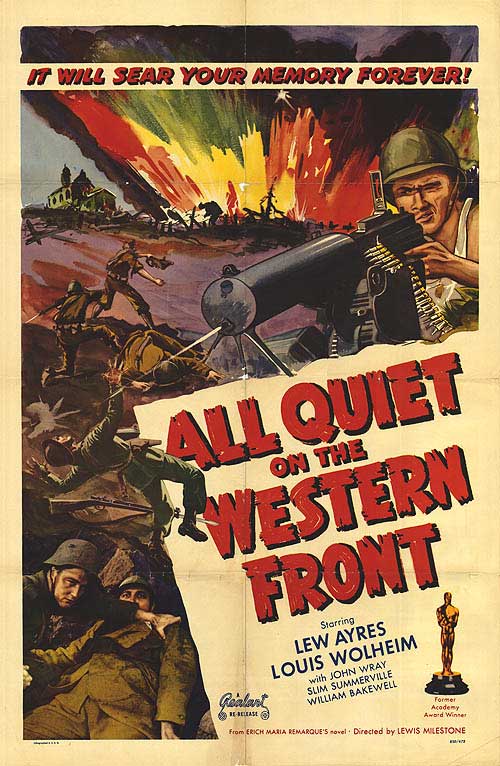
All Quiet on the Western Front (1930) was the third film to win a Best Picture Oscar, but the first in a long line of war films that won Hollywood’s top prize. I wasn’t thrilled to watch this movie because, while I consider myself a bit of a history buff, I find World War I pretty boring. I mean, I know it was called the Great War, but let’s face it, trench warfare=boring on film. I was wrong. This movie really moved me, but I’ll be honest. If you voted for Sarah Palin in 2008, you may not like what you see.
Surprisingly, the movie grabbed me from the very beginning. Just like a great book (which All Quiet on the Western Front was before it was a film) this movie begins with a simple quote posted on the screen to set the tone for the rest of the film. It said,
This story is neither an accusation nor a confession, and least of all an adventure, for death is not an adventure to those who stand face to face with it. It will try simply to tell of a generation of men who, even though they may have escaped its shells, were destroyed by the war...
Whoa, heavy. I knew right then and there that this film would be a drastic departure from the peppy musical The Broadway Melody, which won the Best Picture Oscar the year prior.
All Quiet on the Western Front centers around a young German man named Paul who is convinced by a zealous teacher that fighting for ones country is the most honorable thing a young man can do. Paul and many of his classmates join the German army and begin fighting the French on the Germany/France border. The young men witness death and destruction and begin to see that there is very little glory in war. Many of Paul’s friends die or are injured during the war. After watching one friend die, Paul leaves the medical station and begins to run down the street. He recounts to his fellow soldier that it just felt so good to be alive and breathe in the air.
In another scene (perhaps the most memorable one of the entire film) Paul finds himself trapped in a hole during battle. A French soldier jumps into the hole with him and Paul stabs the Frenchman. He is mortally wounded and cries out repeatedly in pain. Paul is forced to spend the night trapped in a hole with this man he has almost killed. He tries to comfort the Frenchman, but by the morning Paul cannot stand the moaning anymore and he screams for the man to die. Realizing the cruelty in what he has said and tells the Frenchman that he will live and that he didn’t mean to kill him but that he stabbed him because he had to since the Frenchman was his enemy. Paul realizes that without this war, there would be no enemies and tells the Frenchman that he’d be his brother under any other circumstances. He begs for forgiveness and promising to write the man’s wife before the Frenchman dies.
Paul is wounded but survives and gets leave to go home and see his family. He is disheartened to see that all living in his village are so caught up in the war that no one seems to understand what the consequences of all the fighting will be. His father asks him to wear his uniform around and offers strategic military opinions. Paul goes back to the school and visits the teacher that convinced him to go to war. Paul is so upset that he tells all the young men in the classroom how terrible war is. Everyone is disgusted with him calling him a traitor and a wimp.
Paul returns to war to find that all but two of his original comrades are dead. He goes to visit Kat, one of his best friends who is searching for food. A bomb throws shrapnel into Kat’s leg and Paul begins to carry him to the Red Cross center. Another bomb hits and shrapnel hits Kat in the back of the head, killing him. Paul is unaware that Kat is dead and carries him to the medic.
The final scene is the most devastating. Paul is sitting in a trench when he sees a butterfly on the ground outside. Shocked to see such a beautiful reminder of life in the middle of such destruction and death Paul can’t resist reaching out to the butterfly. We see a Frenchman aim his gun. The final image is Paul’s hand, reaching for the butterfly and it suddenly stops. Paul has died. The music stops playing and all is truly quiet on the western front.
Here's the trailer.
According to AFI, this is the 54th Best Film of All Time out of 100.
It’s a heavy film, not for the light hearted and a definite reminder of what war can do to humans. When it was over I had to sit alone for a few minutes just to process what had happened.
If black and white isn’t your thing, never fear. All Quiet on the Western Front is going to be remade, and will star the one and only Harry Potter as Paul.
I’ll absolutely watch this film again. I think it’s an important reminder that there is a negative side to war.