Showing posts with label 1930s. Show all posts

Wednesday, August 4, 2010

Cimarron (1931)

Throughout my Oscar journey I’ve watched many movies I’d never seen, and a few I’d never heard of before. But Cimarron (1931) was the first Academy Award winner I’ve watched that I’d never seen, never heard of, and didn’t understand the meaning of the title. Come to find out, Cimarron is the name for an area of land in modern-day Oklahoma. Which makes complete sense, as the movie is set in Oklahoma. It’s also, coincidently, the name of the main character’s son.


I can’t say that I enjoyed Cimarron. In fact, I spent the entire movie trying to think of just one reason to give it one statuette.

The movie begins with the Oklahoma land rush of 1889. Yancey Cravat is a young lawyer and journalist who wears way too much makeup throughout the entire movie. It’s incredibly distracting. Anyway, he’s in Oklahoma at the beginning of the rush. He knows exactly what piece of land he wants, but is outsmarted by a prostitute looking for a new start. He returns to Kansas where his wife, Sabra, and his young son Cim. He decides to move his family to the booming town of Osage to start a newspaper. Their young African-American servant comes along for the ride as well. More on that later.

Yancey has quite the reputation (and not just for wearing makeup) so the good people of Osage ask him to run their church. During the service, he shoots a guy that he suspects killed the last news paper editor. No one seems particularly bothered about the killing.

The movie skips a year, and we see that the Cravat clan has grown to include a baby daughter, Donna. One day when Donna is an infant, a particularly nasty bank robber named ‘The Kid’ rides into town. After a gun fight Yancey kills him. He’s offered hundreds of dollars in reward, but refuses to take it.

In 1893 President Roosevelt opens up more Oklahoma land for the taking, and Yancey leaves his family in search of a new life. He promises to write, but he doesn’t. Sabra is left alone to run the newspaper and the family. Yancey returns five years later as if nothing had happened, essentially. The day he returns the prostitute from the beginning of the movie (her name is Dixie, I think) is going to trial with hopes that she’ll be run out of town. Yancey decides to defend her, despite the fact his wife Sabra was the one who brought up charges against Dixie. After some quick talking Yancey convinces the court to drop charges. Sabra is understandably upset. I mean, your husband disappears for five years, comes home, and defends a prostitute? I’d be mad too!

The movie moves to 1907 and Oklahoma is officially a state. Oil has been discovered and Yancey is running for Governor. Many in the town want him to devise a plan to trick the Native Americans out of their land, so the townsmen can have the oil profits. Yancey refuses and writes an editorial in the paper defending Native American rights. Sabra is appalled but Yancey prints the piece anyway. He says that one day she will be proud of what he has written.

The movie jumps to the 40th anniversary of the newspaper. Yancey has been gone for many years and Sabra is running the paper. For the anniversary she re-runs the editorial Yancey wrote on Native American rights. She’s just been elected to Congress and there is a lunch in her honor. Her grown children attend, but not Yancey. After lunch Sabra takes the visiting Congressmen from Washington D.C. to the oil fields. When they arrive there is a terrible accident and one of the oil workers is injured. Sabra learns that it is Yancey and runs to him. She holds him as he dies.

The movie ends with the unveiling of a statue in honor of the frontiersmen. The statue is of Yancey Cravat.

Boring.

One cool piece of trivia is regarding the scene I've posted below.  It took one week, 5,000 extras, and 28 cameramen to film it. That's a big deal for back in the day.


Now some thoughts on the treatment of minorities in this film. The movie is blatantly racist against African Americans. It even goes as far as making a watermelon joke. Yeah, it’s bad. But Yancey’s defense of the Native Americans seems rather progressive. It’s a strange dichotomy.

Anyway, this movie is so old and dated it’s almost funny to watch at times. It did not age well.

It was the second film Irene Dunn was in, though she is virtually unrecognizable as Sabra. The movies was nominated for seven Academy Awards and won three.

I seriously will never watch this movie again and I will probably forget it ever won an Oscar. No statuettes from me.

Friday, July 16, 2010

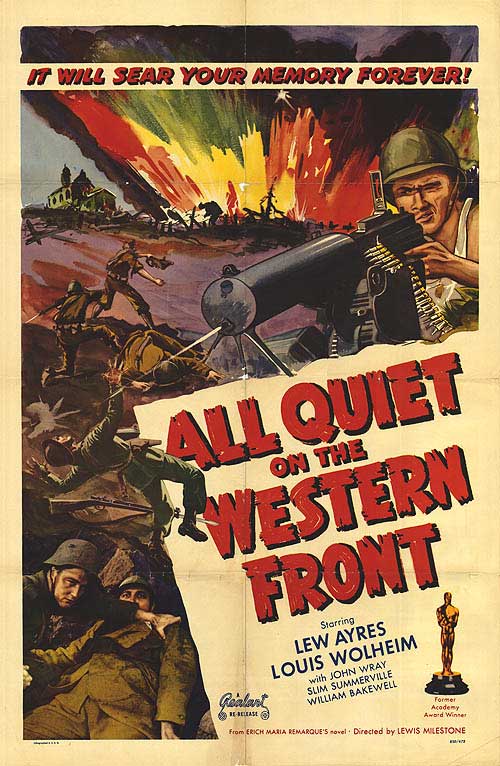
All Quiet on the Western Front (1930)

All Quiet on the Western Front (1930) was the third film to win a Best Picture Oscar, but the first in a long line of war films that won Hollywood’s top prize. I wasn’t thrilled to watch this movie because, while I consider myself a bit of a history buff, I find World War I pretty boring. I mean, I know it was called the Great War, but let’s face it, trench warfare=boring on film. I was wrong. This movie really moved me, but I’ll be honest. If you voted for Sarah Palin in 2008, you may not like what you see.


Surprisingly, the movie grabbed me from the very beginning. Just like a great book (which All Quiet on the Western Front was before it was a film) this movie begins with a simple quote posted on the screen to set the tone for the rest of the film. It said,

This story is neither an accusation nor a confession, and least of all an adventure, for death is not an adventure to those who stand face to face with it. It will try simply to tell of a generation of men who, even though they may have escaped its shells, were destroyed by the war...

Whoa, heavy. I knew right then and there that this film would be a drastic departure from the peppy musical The Broadway Melody, which won the Best Picture Oscar the year prior.

All Quiet on the Western Front centers around a young German man named Paul who is convinced by a zealous teacher that fighting for ones country is the most honorable thing a young man can do. Paul and many of his classmates join the German army and begin fighting the French on the Germany/France border. The young men witness death and destruction and begin to see that there is very little glory in war. Many of Paul’s friends die or are injured during the war. After watching one friend die, Paul leaves the medical station and begins to run down the street. He recounts to his fellow soldier that it just felt so good to be alive and breathe in the air.

In another scene (perhaps the most memorable one of the entire film) Paul finds himself trapped in a hole during battle. A French soldier jumps into the hole with him and Paul stabs the Frenchman. He is mortally wounded and cries out repeatedly in pain. Paul is forced to spend the night trapped in a hole with this man he has almost killed. He tries to comfort the Frenchman, but by the morning Paul cannot stand the moaning anymore and he screams for the man to die. Realizing the cruelty in what he has said and tells the Frenchman that he will live and that he didn’t mean to kill him but that he stabbed him because he had to since the Frenchman was his enemy. Paul realizes that without this war, there would be no enemies and tells the Frenchman that he’d be his brother under any other circumstances. He begs for forgiveness and promising to write the man’s wife before the Frenchman dies.

Paul is wounded but survives and gets leave to go home and see his family. He is disheartened to see that all living in his village are so caught up in the war that no one seems to understand what the consequences of all the fighting will be. His father asks him to wear his uniform around and offers strategic military opinions. Paul goes back to the school and visits the teacher that convinced him to go to war. Paul is so upset that he tells all the young men in the classroom how terrible war is. Everyone is disgusted with him calling him a traitor and a wimp.

Paul returns to war to find that all but two of his original comrades are dead. He goes to visit Kat, one of his best friends who is searching for food. A bomb throws shrapnel into Kat’s leg and Paul begins to carry him to the Red Cross center. Another bomb hits and shrapnel hits Kat in the back of the head, killing him. Paul is unaware that Kat is dead and carries him to the medic.

The final scene is the most devastating. Paul is sitting in a trench when he sees a butterfly on the ground outside. Shocked to see such a beautiful reminder of life in the middle of such destruction and death Paul can’t resist reaching out to the butterfly. We see a Frenchman aim his gun. The final image is Paul’s hand, reaching for the butterfly and it suddenly stops. Paul has died. The music stops playing and all is truly quiet on the western front.

Here's the trailer.


According to AFI, this is the 54th Best Film of All Time out of 100.

It’s a heavy film, not for the light hearted and a definite reminder of what war can do to humans. When it was over I had to sit alone for a few minutes just to process what had happened.

If black and white isn’t your thing, never fear. All Quiet on the Western Front is going to be remade, and will star the one and only Harry Potter as Paul.

I’ll absolutely watch this film again. I think it’s an important reminder that there is a negative side to war.

I give it four statuettes out of five.

Tuesday, July 13, 2010

You Can't Take It With You (1938)


I’ll admit it, it took me a few weeks to get through You Can’t Take It With You (1938). I began the movie when I lived in Lansing and finished it once we were settled into our new home in Grand Rapids. Now, it wasn’t just the move that delayed my finishing this Oscar winner, but the pace at which the first hour of this movie flows. Once the film hit its stride I was able to attach to the story and the strange characters that were living it, though I’m pretty sure the young Jimmy Stewart was what helped me stick this one out.


The tagline for this 1938 classic (“You’ll love them all for giving you the swellest time you’ve ever had!”) isn’t exactly what I found to be truth, though the word ‘swellest’ endears me to the picture.

So here’s the gist:

The entire film centers around one freaky family who all lives together in a large house. There’s Grandpa Martin Vanderhof (played by Lionel Barrymore, great uncle to E.T. great Drew Barrymore) who is the glue that holds the family and the neighborhood together. He doesn’t care much for money and hasn’t paid taxes in over a decade. His daughter writes plays because a typewriter was accidently delivered to the house, her husband who makes fireworks, a daughter who spastically dances around the house like a drunken Anna Pavlova, her son-in-law who is obsessed with the University of Alabama and plays the xylophone, another daughter who is a secretary (yes, after all this craziness all I have to say is she’s a “secretary”) and a few other people who live with them (I’m not sure of their names, relations, or what they do other than make weird things). Okay, so now that you have a clear mental picture of the insanity that this movie centers around, here’s the general plot.

Alice, the secretary daughter works for the Tony Kirby (cutie Jimmy Stewart) and they’re in love. Mr. Kirby, Tony’s dad, is a billionaire who wants to buy Grandpa’s property (if they said why, I must have been deep into a Sudoku and missed it). Tony and Alice want to get married, but Mrs. Kirby isn’t thrilled with the idea. In fact, she’s a pretty cold lady and I’d be scared crapless to be her future daughter-in-law. Anyway, Alice invites the entire Kirby clan over to Grandpa’s house for dinner. The Kirbys accidently arrive on the wrong night, so instead of pretending to be normal the family is acting like their normal wacko selves. Just as the Kirbys are about to flee the insanity, the police bust in and arrest everyone for disturbing the peace and attempting to insight a revolution (I can’t really explain, something to do with the stockpile of fireworks in the basement). While in a holding cell Grandpa realizes that Mr. Kirby is the banker trying to purchase his house. After a bunch of family drama, Alice and Tony break up. Alice flees town and Grandpa resigns to sell his house and follow her. When Alice gets news of this she comes home. She reconciles with Tony, Mr. Kirby has a change of heart and sell the house back to the family, and everyone lives happily ever after.

Love conquered all in 1938, even real estate and cold mother-in-laws.

Head spinning a bit? Yeah, imagine watching 126 minutes of this craziness.

Capra- Stewart had many successful collaborations over the years (It’s a Wonderful Life, Mr. Smith Goes to Washington) that had much more staying power. This just doesn’t really compare to their other films.


I’ll give it three statuettes out of five. I’d probably have to have a box of wine to sit through this again.

Monday, July 12, 2010

It Happened One Night (1934)

It Happened One Night (1934) is one of the best Oscar winners I’ve watched so far. The film had one key ingredient that modern day Academy Award winners don’t – comedy. This movie had me laughing, smiling, and humming along to some silly songs throughout the entire 105 minutes. I actually had fun watching it. If all the Oscar winners were this good, I wouldn’t be dreading having to watch a quarter of the list.

So here’s the gist of it:

Ellie Andrews is a spoiled heiress who is being held against her will on her father’s yacht. He’s ticked because she went behind his back and married an aviator with the name of King Westley (again another old film with strange names…makes me wonder what viewers will think of names like Aiden and Brittany). Anyway, Ellie’s father has had the marriage annulled and this pisses Ellie off to the point of throwing herself overboard. She swims ashore and begins her trek from Miami to New York City. Her father hires a detective agency and offers $10,000 for Ellie’s return to him. She pawns her watch and purchases a bus ticket where she meets Peter Warne, one of my most favorite male characters of all time. He’s a newspaper writer who is down on his luck. Ellie’s purse is stolen, so she becomes dependent on Warne, who is planning to use her for the $10,000 reward. After a few hilarious nights together (including a lesson on how to properly dunk a doughnut that is so charming you won’t forget it) Ellie falls in love with Warne. It takes awhile for him to come around, but the two end up together with the blessing of Ellie’s father. King ends up with nothing, which is fine by me because King is a stupid name.

The most memorable portion of the movie involves the Wall of Jericho. When Warne and Ellie are forced to spend the night together in the same motel room Warne hangs a blanket between their two beds calling it the “Wall of Jericho”. When the two are married they return to a motel and blow a toy trumpet, tearing down the Wall of Jericho. It may sound cheesy, but I LOVED it! They just don’t make movies with this kind of charm anymore.

Here's the trailer.  It really gives you a glimpse into the charm of this film.


This is AFI's 35th Best Film of All Time, out of 100.

Peter Warne is played expertly by Clark Gable, who I’ve never seen in anything except Gone With The Wind, but I will definitely seek out more of his films. He won the Best Actor Oscar for this role and it was well deserved. Claudette Colbert won the Best Actress Oscar for her portrayal of Ellie, but didn’t expect to win. When she found out that she did win, she was at a train station and went to the ceremony in a traveling pant suit (I have no idea what a traveling pant suit is). Anyway, both awards were well deserved.

Watch this on a down day and I promise it will pick you up like a dose of Xanex.


I’ll give it five statuettes, my first perfect score!  I’ll definitely be watching this one again.