Showing posts with label War Movie. Show all posts

Wednesday, August 11, 2010

Mrs. Miniver (1942)

Mrs. Miniver (1942) is the first movie of the 1940s that I watched for the 365 Oscar Project and it definitely felt quintessentially 40s. The movie was made as a piece of World War II propaganda to entice the United States to join the war against Nazism and was advertised as the best movie ever made. Now, I wouldn’t go that far but it was a very good movie.


Mrs. Kay Miniver, the movie’s namesake, is the matriarch of a middle class British family. Well, they claim to be middle class at the beginning of the movie, but they do have a HUGE house and no less than three servants. Kay spends her days shopping and her husband Clem is a successful architect. They have three children Judy and Toby who are younger and Vin who is studying at Oxford. They live in a quiet village – the kind that has flower shows and glee clubs.

Mrs. Miniver is friendly with Mr. Ballard, a man who works at the train station in town. He grew a beautiful rose that he is going to enter into the annual Thames Valley Flower Show. He asks permission to name the rose after Mrs. Miniver, a sign that she is a beautiful and well-loved woman around town.

Vin returns from Oxford and is visiting at home with his parents when Carol Beldon, a young woman from the village, stops by to speak with Mrs. Miniver. She is the granddaughter of Lady Beldon, an older wealthy woman who has never lost the Themes Valley Flower Show. Carol’s hope is that Mrs. Miniver will ask Mr. Ballard to withdraw his rose. Mrs. Miniver won’t, but Carol’s trip isn’t in vein, as she and Vin hit it off.

Eight months pass and war begins in Britain. Vin joins the Royal Air Force, but has promised Carol his heart. The Miniver’s make a few minor adjustments for the war (dark curtains, building a bomb shelter) but they have yet to truly take the war seriously. Vin returns home one night and visits his family. He proposes marriage to Carol and only a few minutes after she accepts his proposal, he is called back to the Royal Air Force. Clem, who is a member of the Themes River Patrol, is called away in the middle of the night. Clem and the other men are annoyed at having to take to their boats, but they soon begin to take the war seriously when they learn they need to take their boats to France to rescue thousands of stranded British soldiers.

Kay wakes up the next morning and takes a walk around the house. She stumbles upon a wounded German soldier. He forces her into the house at gunpoint and demands food and milk. He eventually passes out from blood loss and Kay calls the police and takes his gun. The police come and take the man away. Much like her husband’s experience on the Themes River, Kay is now beginning to understand the seriousness of the war.

Shortly after, Vin returns home married to Carol. They move into the Miniver house, which has been badly damaged by German Air Raids. While they are home, the couple and Mrs. Miniver attend the Themes Valley Flower Show. Mr. Ballard is awarded the grand prize for his rose, the Mrs. Miniver. During the flower show the Air Raid siren goes off. Mrs. Miniver, Carol, and Vin ride to the Air Force base to drop Vin off for duty. Carol is wounded and dies shortly after. Vin returns home a few days later to attend Carol’s funeral.

The best part of the movie is the last few minutes. During Carol’s funeral the pastor gives a rousing speech about how this war is the people’s war and we all must fight. I’ve reprinted it below.

We, in this quiet corner of England, have suffered the loss of friends very dear to us - some close to this church: George West, choir boy; James Bellard, station master and bell ringer and a proud winner, only one hour before his death, of the Belding Cup for his beautiful Miniver rose; and our hearts go out in sympathy to the two families who share the cruel loss of a young girl who was married at this altar only two weeks ago. The homes of many of us have been destroyed, and the lives of young and old have been taken. There is scarcely a household that hasn't been struck to the heart. And why? Surely you must have asked yourself this question. Why in all conscience should these be the ones to suffer? Children, old people, a young girl at the height of her loveliness. Why these? Are these our soldiers? Are these our fighters? Why should they be sacrificed? I shall tell you why. Because this is not only a war of soldiers in uniform. It is a war of the people, of all the people, and it must be fought not only on the battlefield, but in the cities and in the villages, in the factories and on the farms, in the home, and in the heart of every man, woman, and child who loves freedom! Well, we have buried our dead, but we shall not forget them. Instead they will inspire us with an unbreakable determination to free ourselves and those who come after us from the tyranny and terror that threaten to strike us down. This is the people's war! It is our war! We are the fighters! Fight it then! Fight it with all that is in us, and may God defend the right.

Here's the trailer for Mrs. Miniver.


Mrs. Miniver’s director, William Wyler, joined the US Army after making this movie. After having been to war, he said that Mrs. Miniver was too soft a depiction of actual war.

This movie was the first to ever be nominated for five acting Academy Awards. Greer Garson, who played Mrs. Miniver, gave the longest acceptance speech in Oscar history, a whooping 5 and a half minutes. The last piece of trivia – Greer Garson (Mrs. Miniver) and Richard Ney (Vincent Miniver) got married after making this film. Kinda gross since she played his mom.

The Miniver Story (1950) was the sequel to this Oscar winner, but it bombed.

I didn’t love it, but I didn’t hate it. Unfortunately, I found it more charming than anti-war. I think I’ve watched Saving Private Ryan too many times, which sort of tainted my ability to feel anything towards war that isn’t bloody.

Three out of five statuettes from me.

Monday, July 19, 2010

From Here to Eternity (1953)

So many of the films on the Oscar winner list I’ve never heard of or seen, but there are a few that I’ve heard of before and never seen. From Here to Eternity (1953) was one of those movies. I knew I’d heard of From Here to Eternity before, but I could not for the life of me remember why or where. So when I sat down to watch it and discovered that it was another war movie (I had just finished All Quiet on the Western Front) I wasn’t thrilled. I know, I’d better get use to war movies, because a lot of them won Oscars. Anyway, about a half hour into the film I gasped the famous Garvey Gasp known to all in the John Moy family and choked on my Diet Coke. I suddenly realized why I’d heard of this film before. The famous love makin’ on the beach scene! I’ve always wanted to watch that! I’ve never made it on the beach, (the thing about where the sand could get bothers me a bit) but I’ve always wanted to see how it’s done.


Anywho, that’s enough about sex on the beach. To call From Here to Eternity a war movie would be a bit misleading. While it does take place on Pearl Harbor military base on the brink of World War II, it’s really about relationships.
From Here to Eternity focuses on Private Prewitt (played by the attractive Montgomery Cliff), a young man who has been transferred to base at Pearl Harbor. He is a great trumpet player and also a fabulous boxer. Captain Holmes has heard of Prewitt’s boxing ability and wants him to join his regiments boxing team. Holmes promises Prewitt that he could become a sergeant if he chooses to box. Prewitt refuses to join and we later learn that he accidently blinded a man with his golden fists during a boxing match.

Prewitt is treated cruelly by Holmes and the other soldiers on base. His only friend is Maggio (played expertly by Frank Sinatra). No matter what they do, Prewitt does not crack. One night things go too far. Prewitt and another soldier engage in a fight and the other soldier accuses Prewitt of beginning the fight. He is court-martialed by the commanding officer. Holmes, still holding on to hope that Prewitt will box begs for an alternative. The commanding officer demands that Holmes resign his position and leave the army. He does and Captain Ross (who has been boinking Holmes’ wife, including on the beach) is put in charge of the base.

Meanwhile Maggio gets into a nasty bar fight with Staff Sergeant Judson. One night Maggio blows off night duty to go to the bar and is court-martialed for going AWOL. He is placed in the stockade, under the watch of none other than Judson. He is abused in prison. Maggio escapes one night and finds Prewitt, telling him of the horrible torture at the hands of Judson. He dies in Prewitt’s arms. Since Maggio was Prewitt’s only friend he tracks down Judson and the two engage in a knife fight. Judson is killed and Prewitt was gravely injured.

He hides at the apartment of his girlfriend Lorene (played by the one and only Donna Reed) who he met while she worked at a gentlemen’s club. When the Japanese attack Pearl Harbor Prewitt tries to return to his base to help his fellow soldiers but is shot.

It’s a really touching ending to a touching movie. There’s some kind of irony about Prewitt refusing to fight except when it comes to avenging his dead friend.

There were three main highlights of this movie : 1. Sex on the beach, 2. Frank Sinatra (rumored to have received the role through his mafia connections) who won a Best Supporting Actor Oscar, 3. Donna Reed who won a Best Supporting Actress Oscar. I’d grown up hearing about the Donna Reed show, so I was excited to see this famous lady that puts all other housewives to shame. Little did I know she was playing an escort. Scandalous.

Here's the trailer.  Keep watching til 46 seconds to see some necking on the beach.


The movie was nominated for 13 Academy Awards and won eight of them. It ranks 52nd on AFI’s Top 100 movies of all time.

I’ll give it three statuettes out of five. It wasn’t fabulous, but I feel like it’s a movie everyone should say they’ve seen.

Friday, July 16, 2010

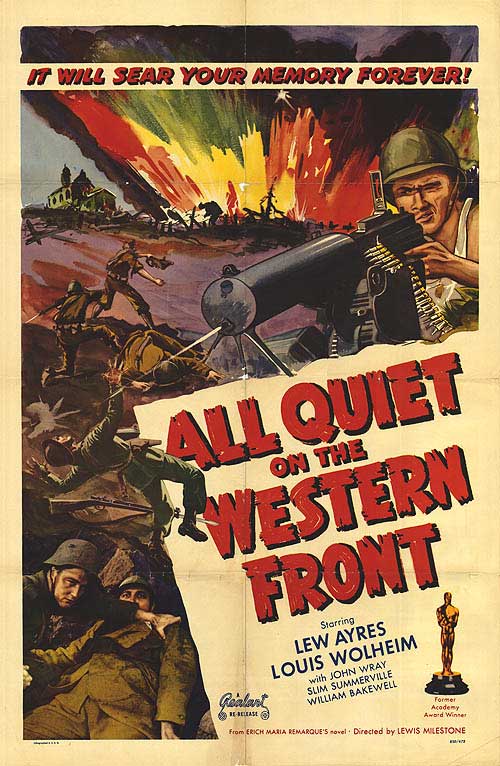
All Quiet on the Western Front (1930)

All Quiet on the Western Front (1930) was the third film to win a Best Picture Oscar, but the first in a long line of war films that won Hollywood’s top prize. I wasn’t thrilled to watch this movie because, while I consider myself a bit of a history buff, I find World War I pretty boring. I mean, I know it was called the Great War, but let’s face it, trench warfare=boring on film. I was wrong. This movie really moved me, but I’ll be honest. If you voted for Sarah Palin in 2008, you may not like what you see.


Surprisingly, the movie grabbed me from the very beginning. Just like a great book (which All Quiet on the Western Front was before it was a film) this movie begins with a simple quote posted on the screen to set the tone for the rest of the film. It said,

This story is neither an accusation nor a confession, and least of all an adventure, for death is not an adventure to those who stand face to face with it. It will try simply to tell of a generation of men who, even though they may have escaped its shells, were destroyed by the war...

Whoa, heavy. I knew right then and there that this film would be a drastic departure from the peppy musical The Broadway Melody, which won the Best Picture Oscar the year prior.

All Quiet on the Western Front centers around a young German man named Paul who is convinced by a zealous teacher that fighting for ones country is the most honorable thing a young man can do. Paul and many of his classmates join the German army and begin fighting the French on the Germany/France border. The young men witness death and destruction and begin to see that there is very little glory in war. Many of Paul’s friends die or are injured during the war. After watching one friend die, Paul leaves the medical station and begins to run down the street. He recounts to his fellow soldier that it just felt so good to be alive and breathe in the air.

In another scene (perhaps the most memorable one of the entire film) Paul finds himself trapped in a hole during battle. A French soldier jumps into the hole with him and Paul stabs the Frenchman. He is mortally wounded and cries out repeatedly in pain. Paul is forced to spend the night trapped in a hole with this man he has almost killed. He tries to comfort the Frenchman, but by the morning Paul cannot stand the moaning anymore and he screams for the man to die. Realizing the cruelty in what he has said and tells the Frenchman that he will live and that he didn’t mean to kill him but that he stabbed him because he had to since the Frenchman was his enemy. Paul realizes that without this war, there would be no enemies and tells the Frenchman that he’d be his brother under any other circumstances. He begs for forgiveness and promising to write the man’s wife before the Frenchman dies.

Paul is wounded but survives and gets leave to go home and see his family. He is disheartened to see that all living in his village are so caught up in the war that no one seems to understand what the consequences of all the fighting will be. His father asks him to wear his uniform around and offers strategic military opinions. Paul goes back to the school and visits the teacher that convinced him to go to war. Paul is so upset that he tells all the young men in the classroom how terrible war is. Everyone is disgusted with him calling him a traitor and a wimp.

Paul returns to war to find that all but two of his original comrades are dead. He goes to visit Kat, one of his best friends who is searching for food. A bomb throws shrapnel into Kat’s leg and Paul begins to carry him to the Red Cross center. Another bomb hits and shrapnel hits Kat in the back of the head, killing him. Paul is unaware that Kat is dead and carries him to the medic.

The final scene is the most devastating. Paul is sitting in a trench when he sees a butterfly on the ground outside. Shocked to see such a beautiful reminder of life in the middle of such destruction and death Paul can’t resist reaching out to the butterfly. We see a Frenchman aim his gun. The final image is Paul’s hand, reaching for the butterfly and it suddenly stops. Paul has died. The music stops playing and all is truly quiet on the western front.

Here's the trailer.


According to AFI, this is the 54th Best Film of All Time out of 100.

It’s a heavy film, not for the light hearted and a definite reminder of what war can do to humans. When it was over I had to sit alone for a few minutes just to process what had happened.

If black and white isn’t your thing, never fear. All Quiet on the Western Front is going to be remade, and will star the one and only Harry Potter as Paul.

I’ll absolutely watch this film again. I think it’s an important reminder that there is a negative side to war.

I give it four statuettes out of five.